
Lex Fridman: “So some people listening to you right now will say DHH is suffering from the old case of AI psychosis. Can you steelman the case that you are, in fact, in a state of delusion, like One Flew Over the Cuckoo’s Nest, and can you argue against it?”
DHH: “I’m in a state of delirium. That’s the state I’m in.” 1
I’ve been following Omarchy ever since David Heinemeier Hansson (aka DHH) announced it on his blog. At the time, I picked up a few UI/UX ideas from Omarchy 3 and recreated some of them on macOS. Over the past year, while macOS 26 Tahoe ushered in what I consider the darkest period for macOS, I’ve actually enjoyed using my Mac more thanks to those modifications and my decision to stay on macOS 15 Sequoia.
A few weeks ago, DHH released Omarchy Quattro and kicked off his grand tour. More recently, he returned to Lex Fridman’s podcast as a guest. I didn’t watch the whole video, but there were a few things I thought were worth sharing and thinking about.
First, at around 2:23:49, DHH talks about how Omarchy integrates an AI agent directly into the operating system so that it can help when something goes wrong. For instance, when an app crashes, a crash watcher pops up and asks whether you’d like to let the agent take a look. I think it’s a brilliant design because we already have coding agents that can deal with bug reports in software development, so why not adopt the same idea system-wide?
And if you watch the video, there’s a slide at around 2:24:17 explaining that some people think Linux error messages are too verbose for ordinary users, but that verbosity is perfect for an agent. Few things are more useful to an agent investigating a problem than detailed diagnostic information, especially when the agent lives right inside the system and much of the software running on it is open source.
I instantly got it, because that’s already how I use agents on my Mac. When something goes wrong and I have no idea how to fix it, I ask an agent to inspect the problem, explain it to me, and then try to fix it.
Omarchy’s agent integration also reminded me that while macOS often surfaces only minimal error information to users, much more detailed diagnostic information is available in system logs. So from an agent’s perspective, much of the groundwork is already there. Apple just needs to make these capabilities easier for agents to access through better documentation, skills, MCP servers, and CLIs. Most importantly, it needs to make sure they’re well maintained.
Second, the quest for speed.
DHH has been proud of how quickly Omarchy can be installed. At the time of recording, the record was around 45 seconds. (I saw one YouTuber install it on an old gaming laptop in about four minutes.) And it’s getting faster! 2
When Fridman asks why he’s so obsessed with getting the installation time below one minute, DHH brings up something Mitchell Hashimoto wrote:
“The pursuit of excellence does not need justification.”3
DHH also gave Fridman a custom Dell XPS laptop and asked him to run a disk speed test.
“What are you getting?” DHH asked.
“7 GB/sec,” Fridman said.
DHH launches into the math:
“So seven gigabytes a second. That’s how fast that drive is. Why can we not install a Linux distribution in one second? The Omarchy distribution is 5.8 gigabytes. If we can run at seven gig… Now, of course, you can’t actually do that because the USB key is a lot slower than that, but you should be able to maximize the underlying physics and protocols that we’re dealing with, and that’s your goal. We gotta get all the way back down to that.”
You can tell how obsessed DHH is with installation speed. Getting it down meant optimizing almost every part of the installation process.
One trick was to treat the time spent waiting for human input as an opportunity to preload things in the background. Omarchy asks users a handful of questions during setup, such as their username, password, and time zone. Instead of waiting for the user to finish, the installer can use those few seconds to get a head start. DHH points out that video games have been doing this kind of preloading for years.
Another was aggressively shrinking the ISO. The previous version was about 7.5 GB, while Quattro was down to roughly 5.85 GB. DHH explains that decompressing package files now accounts for much of the installation time, so reducing the size of the ISO translates almost directly into shorter installation times.
DHH later talks about how long it took him to install macOS and Windows on new machines. I don’t think it’s an entirely fair comparison, but that’s not really the point. When you can install an operating system and set up your environment that quickly, hacking on and even breaking the system becomes much less scary or inconvenient. “So what? I can put things back in a few minutes.”
Once a user, even a grown-up one, develops that kind of mindset, playing around with a computer starts to feel fun and liberating again. Not to mention that now there’s an AI agent at your disposal to help you deal with the consequences of being reckless.
Watching DHH obsess over installation speed also reminded me of something that has frustrated me about macOS software for years. (I’m using macOS as an example simply because it’s the ecosystem I know best.) Many app developers, especially those from large companies, seem to no longer care about user experience, performance, efficiency, or how much disk space their apps take up. I’m not sure whether AI has made this worse, but the trend started long before people began using AI to build software.
I understand that some of these bad development choices are driven by a combination of cost and cross-platform strategy. In other words, it’s about business. I understand that. And it’s almost certainly not because they care about users on different platforms or about how those users feel while using their apps. In the end, it’s also because we, as users, tolerate this kind of laziness and carelessness.
In an age of cross-platform but often mediocre apps, I admire what Mitchell Hashimoto has done with Ghostty. It’s also why I’m eagerly looking forward to what he and his team at Superlogical are building.
Back to the video. When I watched DHH talking about Omarchy and computers, I felt encouraged. His passion was infectious. Perhaps it’s because I watched the video at midnight, or because he is right: things should work that way.
There’s another clip I find entertaining. At around 2:40:58, DHH talks about how one Claude Max account isn’t enough for him, so he has to create another. Fridman says he has four accounts. Then, with a sheepish grin, Fridman says, “And obviously you’ll have to develop some kind of tooling—”
“Yes, I did that too,” DHH jumps in.
At that moment, you realize you’re just watching two people who love talking about computers and comparing notes on how they use them.
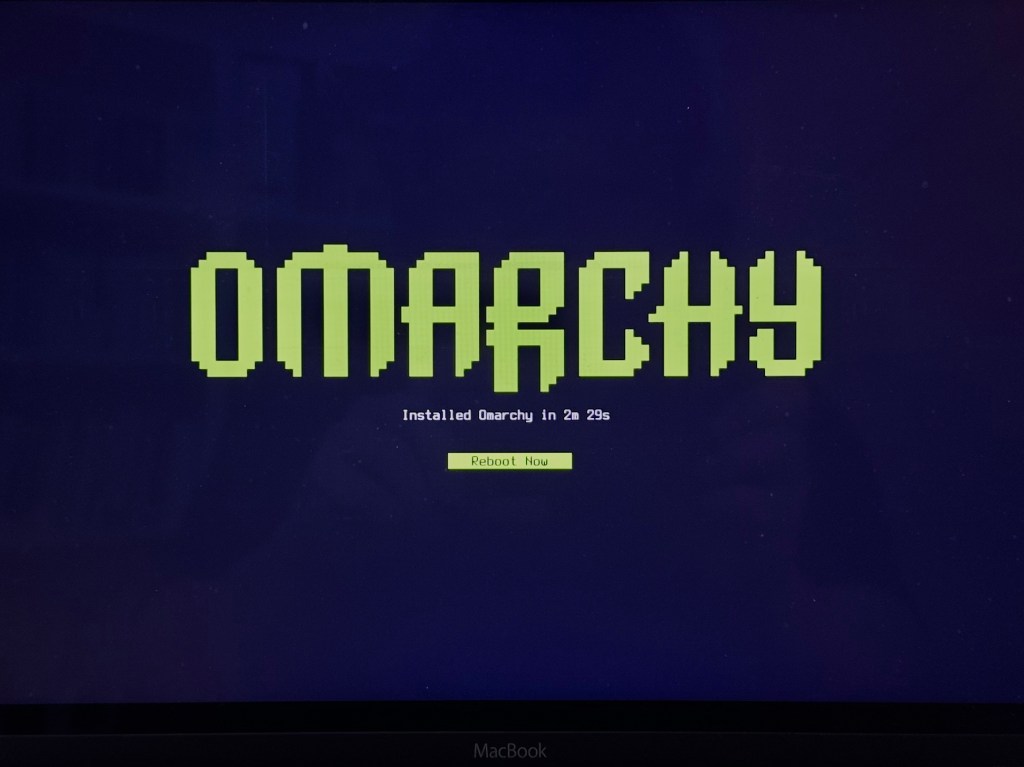
The day after I watched the video, I dusted off my old 12-inch MacBook (MacBook8,1), which I bought in 2015, and installed Omarchy on it with some help from a few posts and, you know, my coding agents.4 It took me some time because I did some research to make sure I could do it right, but the installation itself was quick: 2 minutes and 29 seconds. Soon enough, I got the chance to let the agent inspect an error and fix it. It worked exactly as DHH described. I wouldn’t say I’m in a state of delirium like him, but I was having a great time.
I haven’t used Omarchy enough to share an informed opinion about it yet. That said, I’m not quite as sold on Omarchy as many people in the community seem to be, either as a daily driver or as something that could bring Linux to a mainstream audience. Still, I think it’s a great step in that direction. Let’s save that topic for another post.
As I said earlier, about a year ago I did get inspired by how DHH and ThePrimeagen use their computers. I created a workflow similar to what I learned from the previous version of Omarchy and the way ThePrimeagen switches between apps and desktop spaces. Now I’m sure it works for me. I should have written about it months ago. Hopefully, I’ll get that post out soon.
-
Lex Fridman’s interview with DHH, around 37:21. Lightly edited for clarity and readability. ↩︎
-
DHH’s new record is in 15 seconds. ↩︎
-
Omarchy 4 on 12” MacBook8,1 – Open Web Craft, Omarchy 4 on MacBook8,1 (2015 12”) — fixed applespi -110 keyboard/trackpad issue : r/omarchy ↩︎

